
The Tampere Region’s new integration solution increased efficiency and transparency of information: “Saving time means cost savings”
The Tampere region has more than 400,00 residents, for whom the municipalities provide services in leisure and sports, public transport, and education, among other things. The common integration platform serves the data transfer needs of municipalities and enables the automation of services aimed at municipal residents.
Tampere and eight surrounding municipalities (Hämeenkyrö, Kangasala, Lempäälä, Nokia, Orivesi, Pirkkala, Vesilahti and Ylöjärvi) wanted to upgrade their integration solution a couple of years ago. The aim was to leverage the latest integration technologies and API management to improve information flow, making it more efficient and transparent.
Netum won the tendering process and rolled up its sleeves in autumn 2024 to start the work. Maarit Vehviläinen, Project Manager, ICT Infrastructure at the City of Tampere, describes leveraging data as one of the key drivers of the upgrade, alongside cost-efficiency.
– Data is now shared, managed and maintained through a single platform, which is a huge advantage in meeting the needs of nine different municipalities. Documentation is up to date and easily available to all users responsible for the service, saving time when there is no need to look up where each piece of data is. According to Vehviläinen, saving time means significant cost savings.
The integration platform is now in the city’s own hybrid environment, so the management of the platform is more firmly in one's own hands. The centralised platform is scalable and offers new functionalities as needed, facilitating an agile response to changes in the operating environment. The new integration architecture has also improved information security.
– According to Vehviläinen, a centralised solution is safer because it harmonises information security practices throughout the region.
Jani Alakoski, CIO at Tampere City Region, says that the reform has provided the surrounding municipalities with exceptional access to cutting-edge solutions.
– "In IT, the economy of scale rules. I don't know any other small and medium-sized municipalities that would benefit from such a high-quality integration solution," says Alakoski.
The surrounding municipalities used the previous platform only partially, and a major share of the integrations were traditional point-to-point integrations. The new centralised platform, based on Frends technology, facilitates the migration of existing p2p integrations. In particular, monitoring is more effective, which is vital for managing information critical to society's functioning, such as payroll-related data.
– "The previous integration solutions did not recognise, for example, that no data was being transferred from one system to another as an error. The new solution includes automatic silence monitoring, which means we not only identify incorrect data transfers as incidents but also data that isn't being transferred. This is a major leap forward in the city’s information management." Alakoski says.
Benefits
- Cost efficiency increases: frees up resources for new projects
- Improved information security and error management: A centralised platform facilitates management, monitoring and faster error response
- Meets future needs: The platform scales and offers new functionalities as needed
- Improved transparency of information: Those responsible for the services have real-time visibility into the functionality of the integrations, and in the event of a fault, they receive an automatic alert.
- Increased agility: As the quality of information increases, it is easy to react to changes in the operating environment
- Time savings: Centralised platform and transparent data save time spent on searching for information
Hundreds of thousands of residents affected
The project is also socially impressive. The platform manages information on residents and companies across nine municipalities, including early childhood education, electricity companies, payroll, and public transport. Integration reforms on this scale are often known as demanding and long-lasting processes. However, Juho Elometsä, Netum’s Head of Integrations, says that the project adhered to the original schedule.
– "We stayed on schedule and on budget throughout the project. The moderate costs per integration were a positive surprise to the customer," says Elometsä.
"The multi-organisation model brought its own flavour to the project. There was plenty to coordinate, as nine separate municipal organisations, linked by geography and common interests, operate on the same platform," describes Pekka Nieminen, Netum's Service Manager for the project. Nieminen was responsible for the project's functionality throughout its life cycle: initially defining the operating models and currently serving as both an administrative and service-related person in charge.
– "The deployment of the product itself is fast, and the biggest work often concerns processes. Projects must always ensure that the organisations’ operating models are aligned with the new solution," Nieminen says.
The project started in autumn 2024 with the architecture specifications, after which the platform was deployed. The work was carried out in a workshop-driven manner, facilitating a rapid flow of information and agile decision-making. A pilot project was launched in early 2025, with about ten integrations transferred from the old platform to the new one. Currently, more than one hundred out of the approximately three hundred integrations have been migrated to the new environment, and the migrations should be completed by summer 2026.
After the migration phase, the partnership will transition to continuous services, focusing on the operation, further development, and new integrations of the integration environment. New integrations will be added at an accelerating pace. According to Elometsä, the collaboration has been close and will remain so in the future.
– "Communication with the customer is straightforward, and it has been great to take part in such a significant project with them," says Elometsä.
Vehviläinen from the City of Tampere would also like to thank Netum for the quality of its cooperation and its activity.
– "Netum is extremely proactive in suggesting new development ideas. After all, this is about continuous development," Vehviläinen says.
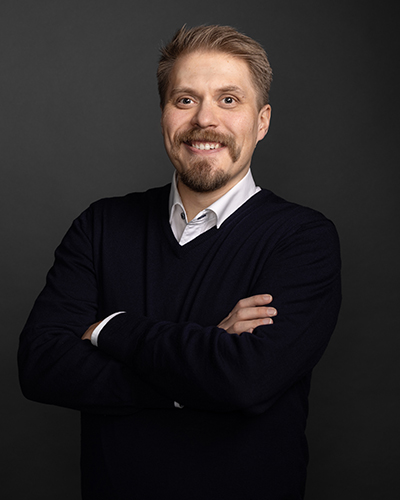
Netum's Head of Integrations Juho Elometsä
Technical solutions
- Frends integration platform
- A hybrid platform that runs both on on-site servers and in the cloud
- Frends centralised management, development and monitoring panel
- Low-code development tools and ready-made connectors
- Frends' built-in API management